MetaboHUB infrastructure

MetaboHUB is the national metabolomics and fluxomics infrastructure created in 2013 as part of the ‘Investissements d'Avenir’ programme launched by the Ministry of Research and Higher Education and the National Research Agency (ANR). MetaboHUB aims to provide cutting-edge technological tools and services in metabolomics and fluxomics to academic research teams and industrial partners in the fields of health, nutrition, agriculture, the environment and biotechnology.
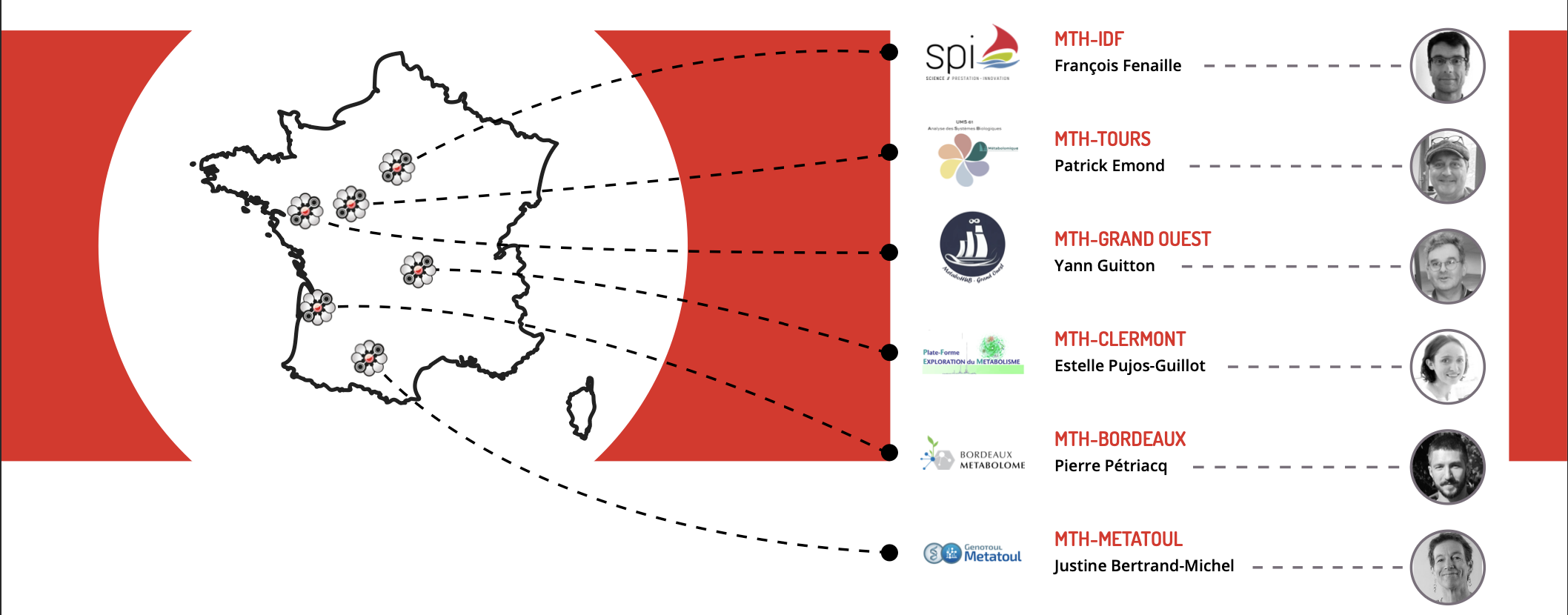
The MetaboHUB infrastructure brings together complementary analytical tools (equipment, analytical techniques, software) and the expertise of six nodes (MTH-MetaToul, MTH-IDF, MTH-GO [MELISA, P2M2, CEISAM-MIMM], MTH-Bordeaux, MTH-Clermont, et MTH-Tours) incorporating 16 facilities.
Its ambition is to develop cutting-edge methods in metabolomics and fluxomics in order to address the technological challenges encountered in the following areas:
| Health, clinical research and medicine |
Human Nutrition and food |
 |
 |
| Agrosciences, plant biology and green biotechnologies |
Microbiology and white biotechnology |
 |
 |
| Ecotoxicology and the environment |
|
 |
|
For each of these fields, the need to explain and optimise biological processes translates into a growing demand for the identification and quantification of metabolites on a large scale and a representation of their dynamic functioning in biological networks. From an operational point of view, there is therefore a need for these fields to have access to structures that bring together the expertise required for the acquisition, interpretation and integration of data using a systems biology approach and that are capable of handling large-scale projects.
MTH's objective is to meet this expectation by addressing the main challenges currently facing metabolomics:
-
- Large-scale metabolic profiling using four complementary analytical approaches (NMR, ultra-high-resolution mass spectrometry, mass spectrometry coupled with liquid and gas chromatography),
- Characterisation of unknown compounds in biological matrices and database construction,
access to metabolic flux dynamics, - Implementation and integration of computer tools for data processing and visualisation.
To achieve this, MetaboHUB is working on:
- developing multi-site technologies enabling high-throughput studies in metabolomics and fluxomics;
- strengthening synergies between infrastructure members (sharing sample preparation protocols, building databases and bioinformatics tools);
providing access to cutting-edge services for the national scientific community and industrial players;
transferring knowledge and skills through training sessions.
Why a national platform?
Metabolomics is a discipline that requires sophisticated equipment and skills. Due to the wide chemical diversity of metabolites, metabolomics requires varied and complementary analytical approaches based mainly on nuclear magnetic resonance (NMR) and mass spectrometry (MS) technologies. These analytical tools are complex to use and require a specialised environment.
The development of metabolomics is closely linked to technological advances in instrumentation, the refinement of computational, statistical and mathematical tools, and the improvement of the skills and expertise of a large scientific community involved in metabolomics research within the framework of integrative biology.
Furthermore, as is the case in genomics and proteomics, metabolomics studies are evolving towards large-scale projects requiring greater and more varied technological capabilities and transdisciplinary expertise to analyse a larger number of samples and handle the considerable mass of data generated. Metabolomics requires numerous analytical tools, some of which are cumbersome to use and costly. Bringing together these tools, knowledge and expertise in data analysis, annotation, management and storage of data and metadata is essential to overcome the current barriers in metabolomics and to be able to integrate the results of this science with other “omics” sciences ". MetaboHUB aims to overcome these technological and scientific barriers by bringing together the cutting-edge equipment, skills and expertise of scientists from the four partner platforms in a single, optimised national infrastructure.